Adjustment of Something
Making sense of the AOS policy memo nobody asked for

Summer should be fun. That’s the going theory, anyway. Tan lines, long weekend getaways out east, or west, a flight somewhere with people you like. Easy.
For a lot of the good people I work with every day, the summer of 2026 is shaping up to be something else. Certainly an adjustment.
Minesweeping intensifies
If you played Minesweeper on a Windows desktop sometime between 1992 and your first desk job, you have an idea of the feeling. You click around the safe edges of the board, the numbers stay low, you build a little momentum. And then you turn over a square that reads 5. Five mines in the eight squares touching this one. The board has not changed. Your understanding of it has.

That, more or less, is where the adjustment-of-status landscape sits this summer after a tumultuous Memorial Day weekend. The statute (INA § 245(a)) hasn’t changed. Your file hasn’t changed. Most of the adjustment to the “new” policy, so far, has been to a revived awareness of the mines surrounding immigration practitioners and our clients.
An exercise of discretion that used to be granted as a matter of course to spouses, parents, employees, experts, entertainers, and artists immigrating to the U.S. based on rigorously vetted and approved immigrant visa petitions is now upended in favor of… something.
Nonimmigrant visas and the intent they represent
When a consular officer issues a nonimmigrant visa, they are certifying that the applicant convinced them of a specific temporary purpose. A B-2 is for tourism or visiting family. An F-1 is for a defined course of study. An H-1B is for a specific job with a specific employer. An O-1 is for applying expertise to particular projects or engagements. The nonimmigrant visa is not a general-purpose travel pass with the holder’s name on it, no matter how nice the holder is.
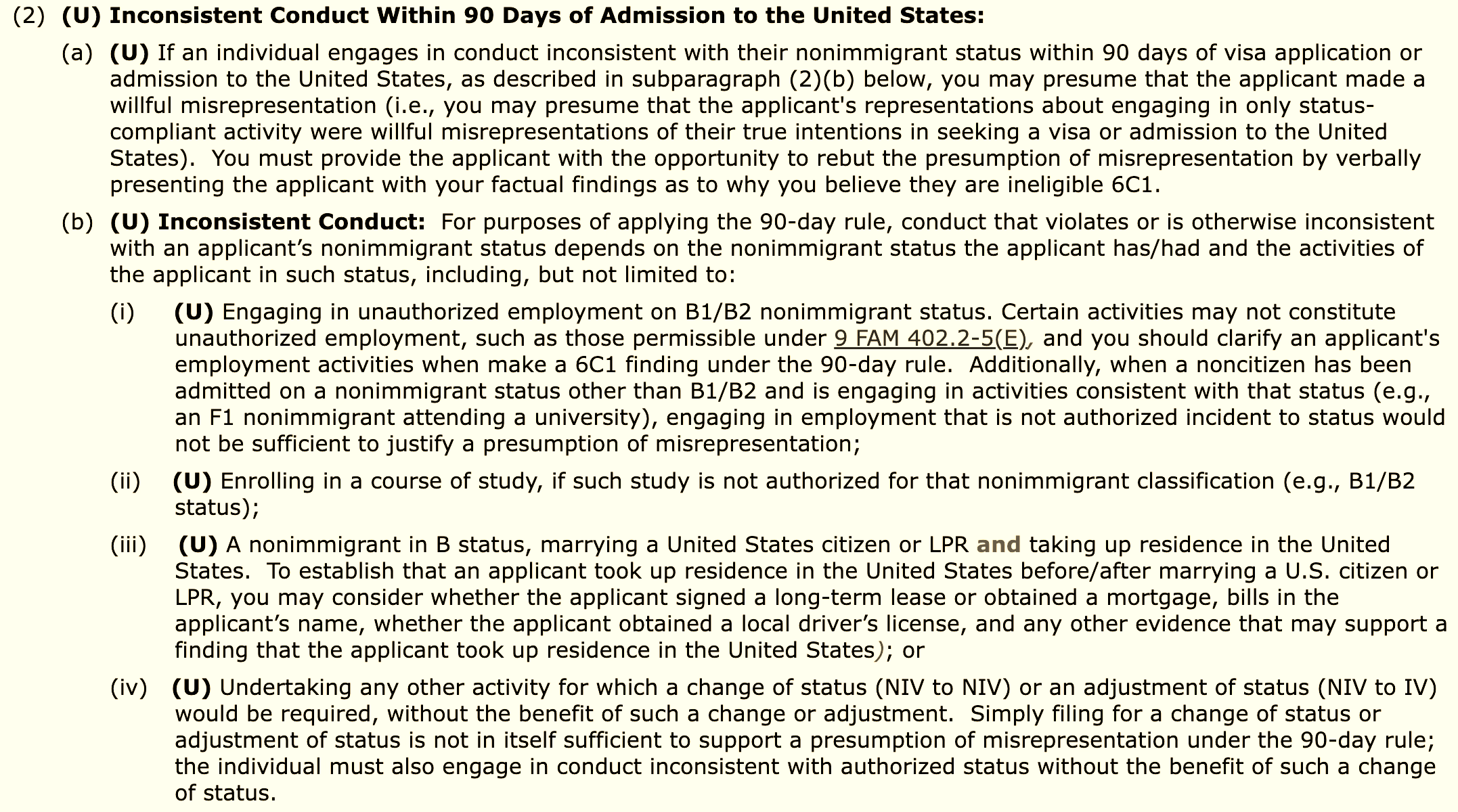
The Department of State has traditionally used a 90-day rule at 9 FAM 302.9-4(B)(3) to police the distance between an applicant’s original theoretical use case and the reality of their subsequent activities in the U.S. If a person enters the U.S. and within 90 days engages in conduct inconsistent with the visa they used — unauthorized work, unauthorized study, marrying a U.S. citizen and settling, or any activity that would have required a different status — DOS presumes they misrepresented their purpose at the visa interview and/or port of entry. The presumption is rebuttable. The burden, however, flips to the applicant, and a finding of willful misrepresentation under INA 212(a)(6)(C)(i) results in lifetime inadmissibility absent a waiver. After 90 days the presumption goes away; the applicant’s exposure does not.
That has always been one of the mines on the board. Practitioners and applicants generally knew where it was and did their best to avoid it.
Reigniting long-dormant mines
On May 22, 2026, USCIS issued Policy Memorandum PM-602-0199, reframing adjustment of status under INA 245 as “a matter of discretion and administrative grace” — extraordinary relief, not the default route to a green card for someone already inside the country and otherwise clearly eligible for permanent residence, as we’ve grown accustomed in response to countervailing and long-standing AOS policies.
The memo does not change or supersede the statute. It instructs officers to weigh, as part of the discretionary balance, whether the applicant’s “failure to depart as expected” is connected to an intention to reside permanently in the United States when they could have used the ordinary consular immigrant visa process. The act of staying-and-adjusting itself now sits, in the memo’s framing, on the negative side of the discretionary ledger. Even dual-intent applicants are not insulated — holding H-1B or L-1 status, the memo clarifies, is not by itself sufficient to warrant a favorable exercise of discretion. The category gets you past the eligibility door. Under the memo’s plain terms, it no longer carries you across the discretionary threshold.
The reliance problem
For a generation of applicants, adjustment of status, or “AOS,” was the smooth path to permanent residence. You entered lawfully, maintained status, met the eligibility criteria, filed, and waited. People have already made real-life decisions on that premise — leases, jobs, school enrollment, family planning, declining offers abroad. The premise was reasonable because, statutorily, it aligned with the government’s expected exercise of discretion.
PM-602-0199 retroactively reframes that reliance as a problem. The applicant who could have consular processed but chose not to is now being asked, in effect, to justify the choice — even though the choice was made in good faith on a settled understanding of how 245(a) worked. The government’s response to that good faith is, more or less, well, you should have known better. Should we have?
Telling that applicant to just consular process now, in May or June or July of 2026, is not a neutral instruction. It is, in many cases, a punchline. Whether field offices will operationalize the memo aggressively or treat it as guidance with marginal effect remains to be seen. What we are seeing on the ground is mixed: some AOS adjudicators appear to be holding off on decisions until further implementation guidance is issued by the Department, while others have started adopting the memo’s framework, issuing requests for evidence targeted at the positive-versus-negative discretionary balance. Either way, practitioners and applicants should prepare for delays or even derailment of previously clear-cut cases.
The three traps in “just consular process”
The implicit recommendation woven through PM-602-0199 — that an applicant who can’t justify a favorable exercise of discretion should depart the U.S. and consular process — assumes the alternative path is open. For a large share of the people the memo is actually aimed at, it isn’t.
Setting aside the procedural challenge of converting long-pending adjustment cases to consular processing, there are three common traps that applicants need to consider before taking any action:
Trap one: the 90-day rule. As discussed above, conduct within 90 days of entry that is inconsistent with the nonimmigrant visa used to enter creates a rebuttable presumption of misrepresentation at INA 212(a)(6)(C)(i). A finding of willful misrepresentation results in lifetime inadmissibility, waivable only in narrow circumstances. The applicant who entered as a visitor, married a U.S. citizen within 90 days, and is now being told to go consular process is effectively being told to go raise that issue at the immigrant visa interview without the safety net of an already-pending I-485. And it could take months or, in some cases, years to get through lengthy immigrant visa processing queues at U.S. consular posts worldwide.
Trap two: unlawful presence. INA 212(a)(9)(B) imposes a 3-year bar on reentry for applicants who accrued more than 180 days of unlawful presence and then departed the U.S., and a 10-year bar for those who accrued a year or more prior to departure. Adjustment under 245(a) is what historically protected immediate relatives — the spouses, parents, and minor children of U.S. citizens — from this trap, because adjustment grants lawful status without requiring a departure that would trigger the bar. Consular processing does not have that feature. The moment the applicant departs to attend the immigrant visa interview, the bar attaches. The I-601A provisional waiver exists and is, for the textbook hardship case, navigable — but it adds many months or years to the timeline, requires a separate evidentiary showing of extreme hardship to a qualifying U.S. relative, and is itself discretionary. The memo implies that a population Congress specifically protected from this trap ought to walk into it.
Trap three: a labyrinth of entry restrictions. Even if traps one and two are clear, the intending immigrant may be a national of one of the 40 jurisdictions covered by Proclamation 10998 and the related domestic adjudication hold, or one of the 75 jurisdictions on the immigrant visa pause. For those applicants, the consular path is not a path at all — they cannot return, or their immigrant visa case will languish in administrative processing with no announced timeline or relief in sight.
The traps stack because a single applicant can be exposed to all three at once. A spouse of a U.S. citizen who entered on a visitor visa, married within 90 days, accrued unlawful presence after the I-94 expired, and is a national of one of the covered countries faces every trap simultaneously. PM-602-0199’s implicit alternative — “just consular process” — accounts for none of these traps. The legal doctrine that produces them is enforced by the same government issuing the memo. It’s almost as if they designed it that way…
The map, on closer inspection
Proclamation 10998, effective January 1, 2026, fully or partially suspends entry for nationals of 40 jurisdictions. USCIS layered a domestic adjudication hold and retroactive re-review on those same 40 under PM-602-0192 and PM-602-0194 — meaning even people who already have approved petitions or green cards are subject to having those benefits re-opened. A January 14, 2026 cable added a third layer: an indefinite immigrant visa processing pause for nationals of 75 countries — most of the 40 plus 52 additional jurisdictions that weren’t on the entry ban — citing public charge concerns.
As of May 18, 2026, the CDC has invoked Title 42 to suspend entry for noncitizens physically present in the Democratic Republic of the Congo, Uganda, or South Sudan within the previous 21 days, in response to the Bundibugyo Ebola outbreak. Three countries that were already, respectively, on the public-charge IV pause (DRC and Uganda) and the full travel ban (South Sudan). Same countries. Different justification. Same effect. Embassy operations across parts of the Middle East and Ukraine remain disrupted by conflict — a fifth layer that, once counted, pushes the total north of 100 jurisdictions facing at least one form of restriction.
We maintain a live map of all of it at jradaimmigration.com/map, most recently overlaid with the Title 42 public-health restrictions.

What that means at the practitioner level: a national of one of the 40 travel-ban-plus-hold jurisdictions who departs to consular process may find their previously approved petition re-reviewed with no lawful path back. A national of any of the 75 jurisdictions on the immigrant visa pause will sit refused under 221(g) indefinitely. Someone whose home consulate is disrupted by conflict or epidemic may not be able to get an interview at all.
If you do stay and adjust, maintaining an underlying NIV status matters more than ever
Maintaining your underlying nonimmigrant status while the I-485 is pending is no longer something to treat as a formality. In the new posture, it may be the central proof that the discretionary balance should come out in your favor — a clean record of compliance with the status you used to enter, used continuously, and maintained without lapse.
The applicant who lets their H-1B, L-1, O-1, E-2, etc., lapse on the theory that the EAD will cover them is operating on a 2023 set of assumptions in a 2026 adjudication environment — one where the government has now framed an otherwise routine legal strategy as a potential negative factor or, worse, some kind of pernicious “attempt to avoid the ordinary consular immigrant visa process.” This despite decades of policy and case law prescribing that very path to permanent residence in hundreds of thousands of cases, decided, pending, or forthcoming.
Those assumptions were already shaky for an unrelated procedural reason. As I wrote in my last article, State of the Onion, the interim work and travel benefits that AOS applicants used to rely on have ceased to function as a meaningful safety net. USCIS’s own published processing times now show advance parole sitting at 22 months — which is to say, the document designed to let you travel while your case is pending will, in many cases, arrive after the case is decided. The automatic extension for EAD renewals has been cut from 540 days to 180, or eliminated entirely depending on category. Asylum EAD validity has been slashed from five years to eighteen months, funneling more applicants through more renewals into the same backlog more often.
The pattern across these proclamations and memos is consistent. Every fallback the AOS applicant used to rely on — interim work authorization, travel via AP, the consular-processing safety valve — is being narrowed at the same time, by the same agencies, for reasons that conveniently never seem to converge. The underlying nonimmigrant status is the one piece of that puzzle you still control. Hold onto it if you can.
Where you click next matters
If you are traveling on a nonimmigrant visa this summer, the visa-purpose rules have not relaxed. The conduct of your stay needs to match the visa you used to enter. If your plans evolve after entry, address that through the right filing before you act on the change, rather than after.
If you are inside the U.S. with an AOS application pending or planned, the conduct of your entire nonimmigrant stay may now be made part of the I-485 record in a way it was not before May 22 — and the alternative path the government is implicitly recommending may not exist for you. Maintain your underlying status. Document everything. The discretionary balance can now make or break the case.
Eligibility still matters. But the day when meeting the statutory requirements was, practically speaking, enough to get to the finish line — that day is over. And for many people, so is the option of starting over from abroad.
The board may not have changed, but our understanding of it has. Contact me at jack@jradaimmigration.com if I can help scope out your next move.